Key pointers from the MS Learning path for PL-300 Power – BI Mobile Apps 1. Microsoft Power BI offers a set of mobile apps for iOS, Android, and Windows devices. These mobile apps let you connect to and interact with your cloud and on-premises data when you’re on the go, anytime, anywhere. 2. All theContinue reading “All about Power – BI Mobile Apps (PL-300)”
Tag Archives: Power BI
A-Z COUNT DAX Functions (Statistical)
In this post, we are going to learn all the COUNT related DAX fuctions. 1 – COUNT() The COUNT function counts the number of cells in a column that contain numbers. Syntax: COUNT() For example, The following example shows how to count the number of values in the column, ShipDate. COUNT EX = COUNT(InvoiceDetails[InvoiceNumber]) ThisContinue reading “A-Z COUNT DAX Functions (Statistical)”
Calculated Column vs Calculated Measure
Calculated Column vs Calculated Measure is the most commonly used term in Power BI. Both these features have many roles to play and it is important to understand the difference. You may ask why? Yes, using it appropriately will save you a huge amount of space in your report. If you understand that the mainContinue reading “Calculated Column vs Calculated Measure”
Helpful DAX resource
Do you know the common DAX functions can be easily learned in Power BI? DAX is simple to learn at a basic level, but advanced DAX skills require a deep understanding of storage & calculation, data engines, table & filter functions, relationships, iterators, etc., hence we need helpful resources. Let’s see the four helpful DAXContinue reading “Helpful DAX resource”
DATEADD vs DATEDIFF vs DATEBETWEEN vs DATESINPERIOD
In this post, we are going to learn about the DATEADD, DATEDIFF, DATEBETWEEN, and DATESINPERIOD functions. These functions are very useful when dealing with dates. DATEADD Function (DAX) Definition: Returns a table that contains a column of dates that has been shifted or moved by no of intervals mentioned in the field. The result isContinue reading “DATEADD vs DATEDIFF vs DATEBETWEEN vs DATESINPERIOD”
How to move measure from one table to another in Power BI
Recently, I struggled to move the measures which I have created under wrong table in Power BI. I found an easy solution and here I’m with the post documenting my learnings. The ability to move measures from one table to another table exists in Power BI. The process is simple and much better than re-creatingContinue reading “How to move measure from one table to another in Power BI”
AllSelected & AllNoblankRow (DAX)
The filtering functions let you manipulate data context to create dynamic calculations. Today, lets learn about the new filter functions named AllSelected() and AllNoblankrow(). The filter functions in DAX are some of the most complex and powerful, also differ greatly from Excel functions. Check out the post for most commonly used functions All() & AllExcept().Continue reading “AllSelected & AllNoblankRow (DAX)”
All vs Allexcept
All and Allexcept are useful filter related DAX functions which will help in data analysis many ways. The ALL () Function returns all the rows in a table, or all the values in a column, ignoring any filters that might have been applied whereas ALLEXCEPT() ignores all the filters applied except the one called under parameters.Continue reading “All vs Allexcept”
Sum vs SumX DAX
Lets begin by looking at the difference between the two of the most commonly used DAX function Sum and SumX in Power BI. In Layman words, SUMX is the sum of an expression iterated row by row, but whereas SUM is just summarizing values of one single column. Lets deep dive in detail with examples.Continue reading “Sum vs SumX DAX”
Date and Time Functions (Basic)
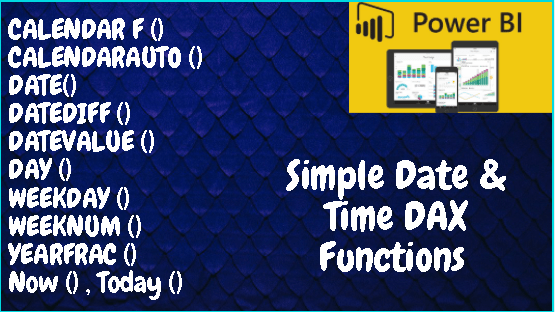
Date and Time Functions (DAX): Just like in MS Excel, there are a lot of similar DAX functions to work with Date and Time-related data in Power BI. They are very useful in many scenarios when dealing with data analysis or while representing dashboards using weeknum, quarter, or yearly data. Let’s explore the basic onesContinue reading “Date and Time Functions (Basic)”
 LR Virtual Classroom