In this article, sharing the recent learning on answers to What, Why, How of Cloud Computing.
What is Cloud?
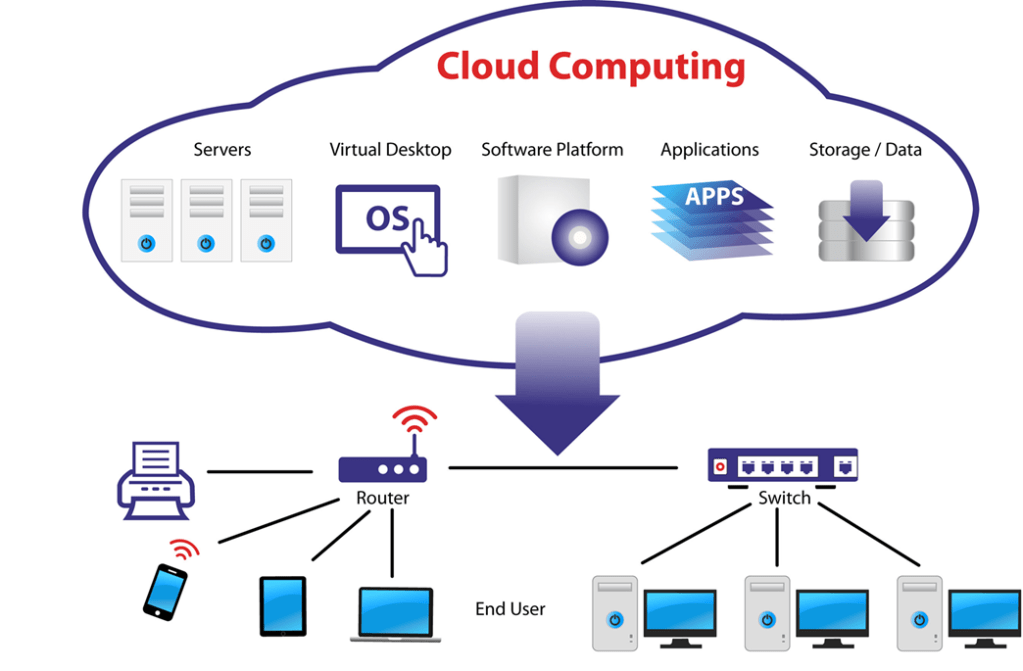
•On demand computing resources delivered to you over the internet.
•Data Centre managed by other companies called as Cloud Providers
•Enables activities like compute, database , storage instantly.
•Provide services like Virtual machines, Relational Database, File Storage etc.
•Host a web app, big data analytics, smart home etc.
•Connect anywhere in the world with routers & switches.
Why Cloud?
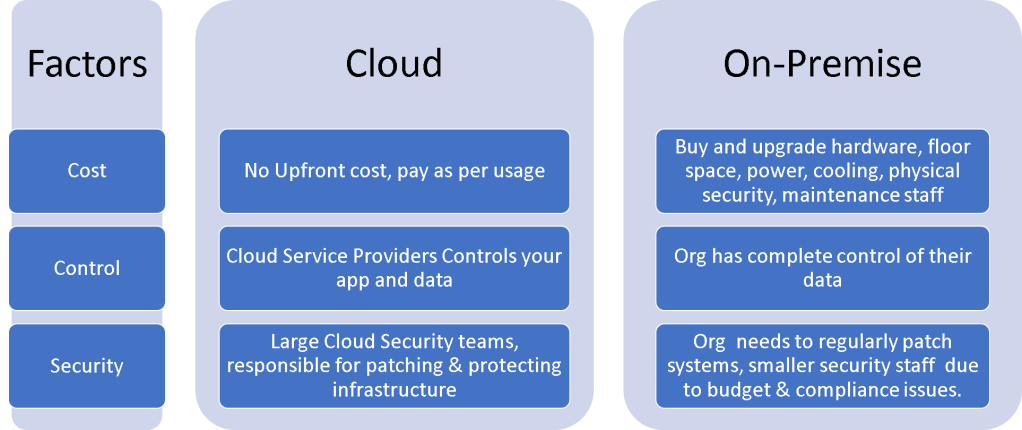
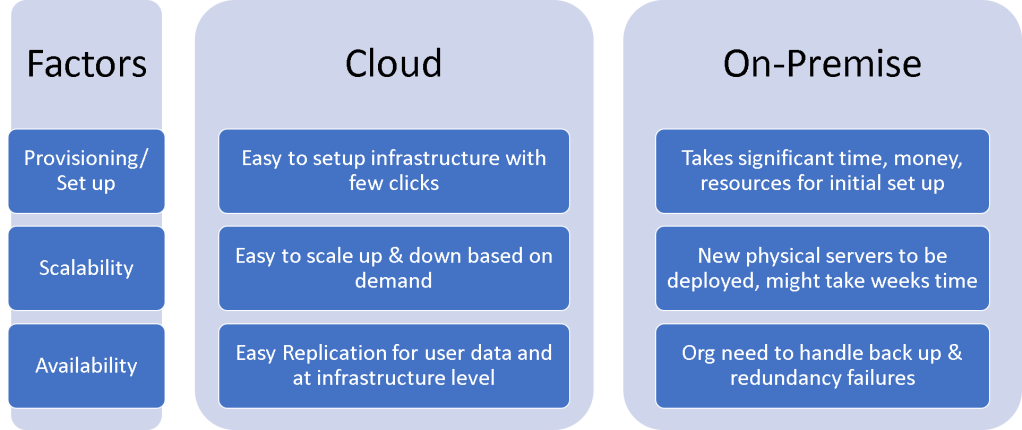
Comparisons of Cloud vs On Premises:
Factors for Selection
Depends On What Works For Your Architecture & business needs. Based On Factors like
- Cost
- Performance
- Compliance
- Security
What type of Deployment models in Cloud?
It is important to know both the Deployment models and Service Models of Cloud Computing.
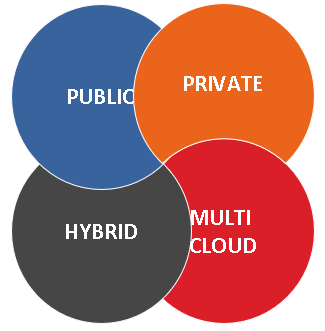
Let’s learn about the various deployment models and its advantages. There are 4 types of deployment models.

Let’s view in brief:

- Cloud services are available over the public internet.
- Never see, know, or have physical access to hardware.
- Huge Impact on Deploying an application that leverages a service hosted in the wrong geographic region.
Advantages:
- Maintenance Free
- Low cost
- Availability
- Scalability

- Dedicated environment & services to a single company
- Can either be hosted on-premises or at a datacentre managed by a third party for customers.
Advantages:
- Customization
- Visibility & Control
Disadvantages
- Responsible for complete utilisation
- Scalability costs more

- Use of both public and private clouds
- Communication between specific services in public and private clouds to be established
Advantages:
- Control on data
- Less space than private so cost effective
Disadvantages
- Operational complexity- Lack of tools that manage both Private/ Public cloud.

- Leverages cloud computing services (storage, computing, applications, etc.) from more than a single cloud provider.
- A multi-cloud model can include the use of a hybrid cloud, but it relies on more than a single public cloud.
Advantages:
- Reduces risk of single point of failure.
Disadvantages:
- Governance related issues
Different types of Cloud Service Models is discussed in next article.
Addins (3) Advanced Excel (18) Agile (23) Blog (21) business (1) Clarity (3) Cloud Computing (3) Confluence (3) Dashboards (21) Data Analytics (17) Data modelling (9) DAX (17) Downloads (2) excel (1) GenAI (8) Jira (12) kanban (1) KPI (2) Loop (1) Motivation (3) MS Project (1) MS Teams (3) OneNote Tutorial (2) Outlook (1) PMO (72) Power BI (50) Power BI Dashboards (1) Power BI Desktop (28) Power BI service (2) Powerpoint (5) Power Query (3) Product Development (2) Productivity Tips & Tricks (59) project-management (4) Project Governance (2) Project Online (1) Ravindrapandian (1) Roadmap (2) scrum (5) scrum-master (2) Sharepoint Online (2) Smartsheet (5) Sway (1) Team Bonding (1)
Discover more from LR Virtual Classroom
Subscribe to get the latest posts sent to your email.
 LR Virtual Classroom