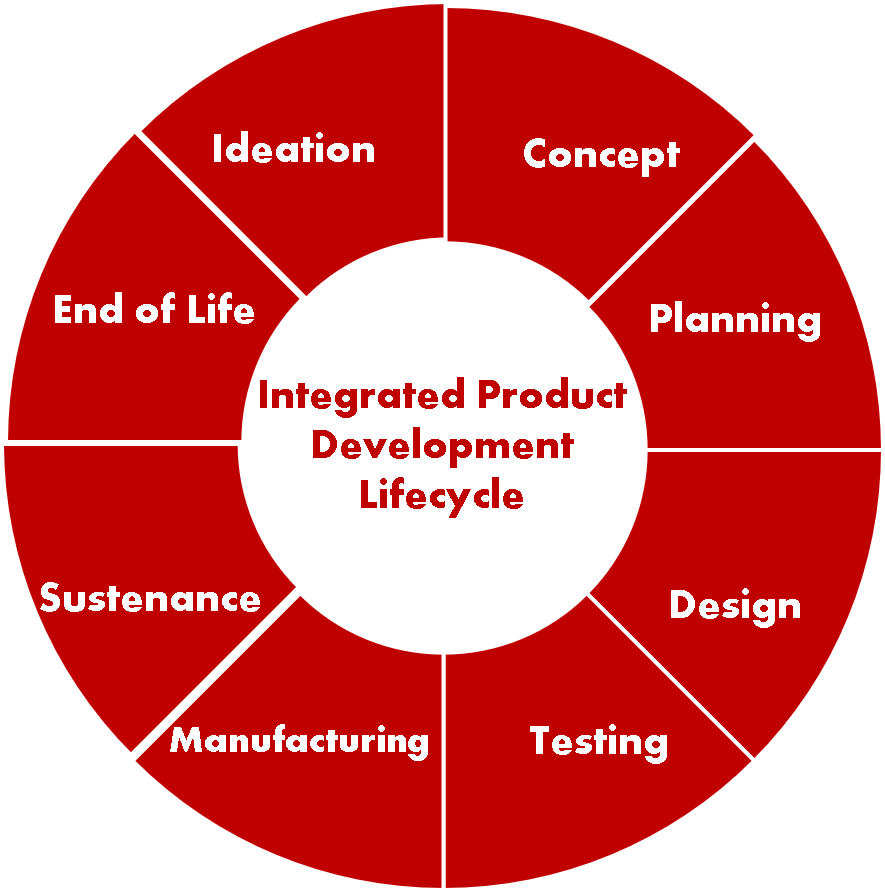
Integrated Product Development Lifecycle defines the end-end process involved in delivering a new product or improving an existing product to the customer. Below elaborated the product development lifecycle in a nutshell based on my experience in Product Organizations. The activities that you perform in each phase is enormous and it also depends on the industry as well.
For example, the design & documentation reviews and quality cum audit compliance related activities are enormous in Life Depended Industrial Products like in Aerospace, Pharmaceutical, Construction etc.
In Software related industries, the success of of the product lies mainly in the performance and adapting the latest innovations and top-notch / cutting-edge technology.
With the current advancements in Tools and Technology and demand in new solutions, it is important to have reduced time to market by accelerating the design development process and in turn move from Ideation to Go-Live in a short span of time.
Few of the activities will be overlapping with the phases depending upon the product requirements which is explained below.
For example, for the products involving the hardware components, the supplier identification & supplier contract will be initiated in the Preliminary Design Phase as soon as the preliminary BOM is ready in order to place the order for long lead parts. Also Product certification, Compliance & regulatory related activities will be initiated from the Planning Phase itself and finalized in Integration.
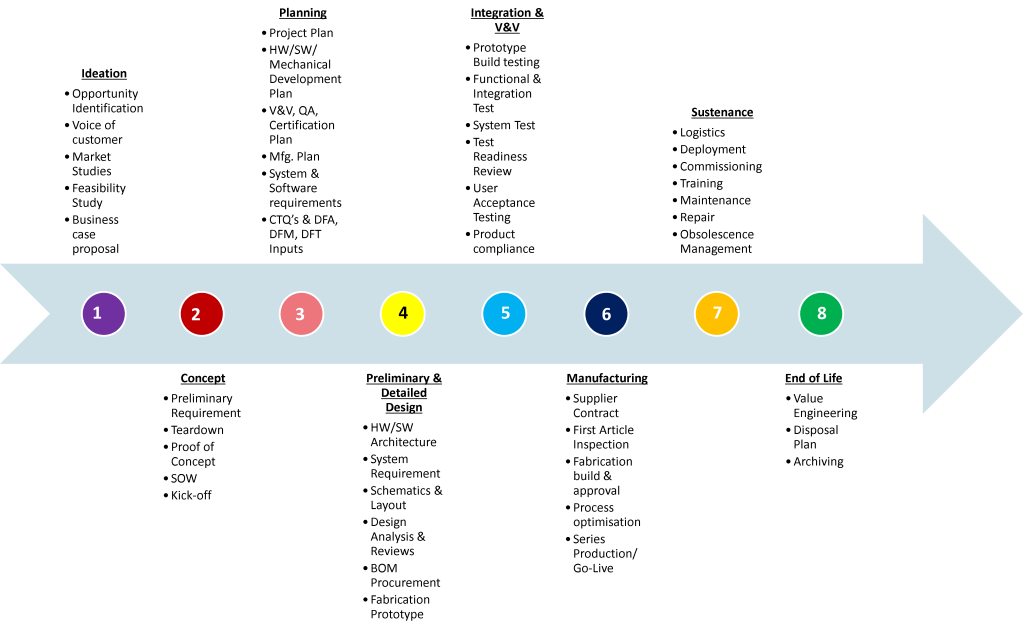
Ideation:
The first phase begins with the Ideation where the opportunity is identified through the voice of customer , market studies. The high-level technical feasibility study is important to be done in this phase to finalise the ideation of the new product.
Conceptualization:
The second phase is Conceptualization where preliminary product requirements is initiated.
- In case of re-design & re-engineering products, you will be entitled to do tear down analysis. By the end of the phase, the Techno-Commercial proposal along with Statement of Work (SOW) is ready.
- Once the project contract is signed, you are all set for Program Kick off.
- In this phase, you can decide if you want to do for rapid prototyping of your product – also called as Proof of Concept (POC) while working side on detailed plan.
Planning Phase:
The third phase is Planning Phase. The entire System, Hardware (HW), Software (SW), Mechanical requirements (Mech) are identified in detail and documented.
- It is also important to prepare the various plans like Quality Assurance (QA), Verification & Validation plan (V&V), Configuration Management plan, Certification plan, Manufacturing Plan, Supplier Management plan & Test Plan etc.
- The requirement inputs for the DFx (Design for excellence), DFA (design for assembly), DFM (design for manufacturing), DFT (design for testability) is complete in this phase which leads to identification & finalization of Product CTQ’s.
By the end of the phase, Detailed Program Plan / Schedule with all the program milestones & deliverables are baselined.
Design Phase:
The fourth is Preliminary & Detailed Design phase (Implementation). The preliminary phase begins with the System, HW, SW & Mechanical architecture design. The preliminary BOM ( electrical/ mechanical components) is identified for initiating the procurement of long lead parts.
- The detailed design phase begins with PCB Schematics & layout design (Gerber files) with all the necessary analysis.
- The SW design in terms of specifications, architecture, interface and development is been done in this phase.
- All the mechanical drawings, tools & fixtures are finalized.
- Post which the fabrication (Build) for the prototype of the product is initiated and proceeded with the subsequent testing phase.
The phase has the key achievement of Critical Design Review (CDR) & Approval with customer for Go-ahead. The cost of the product will be utmost known in this phase.
Testing Phase:
The fifth phase is V&V / Integration. The HW, SW & Mechanical module testing is done at the prototype. All the Component/Unit level verification & validation testing along with the HW & SW Functional, Integration testing is done.
The product undergoes the Test Readiness review (TRR) and final qualification test and ready for manufacturing & deployment.
Product certification & regulatory compliance related activities are complete in this phase.
Manufacturing Phase:
Manufacturing Phase also termed as Build / Deployment phase begins with the System level Integration & User acceptance testing. Process, Procedures, Product training documents are finalized.
If the prototype is working successfully or completed the Pre-Go-Live, the product is ready to get into the Customer’s hands. This indicated the transition from Testing to Production phase.
Meanwhile, Sales & Marketing team will work together with finance for determining your cost of goods sold (COGS) and in turn determine a retail price and gross margin to start targeting the customers for your product.
In case of System Development, Series production begins with finalized DFX, DFA, DFM, DFT. Lessons learned and process optimization during the manufacturing is documented.
It is important to note that Product Lifecycle involves both the Manufacturing/Build and the Marketing of it.
Sustenance Phase:
The seventh phase is Sustenance phase also termed as Aftermarket or Maintenance phase.
- The installation, logistics, commissioning is initiated in this phase.
- Any maintenance, repair or field support is taken care of.
- Obsolescence management is critical as part of the sustenance phase.
- Any warranties, updates/upgrades, patches are all taken care in this phase.
End of Life:
The last phase is End of Life (EOL). The product can reach the end of life due to various reasons.
- Product becomes obsolete
- Product is no longer viable
- Product not meeting the latest technologies
- Product no longer meets the requirements
- Product not able to fulfil the profitability thresholds.
The product replacement plan or disposal plan is implemented with complete archiving.
Capturing the key lessons learned & archiving all the documents is important and also communicating the same to the end users.
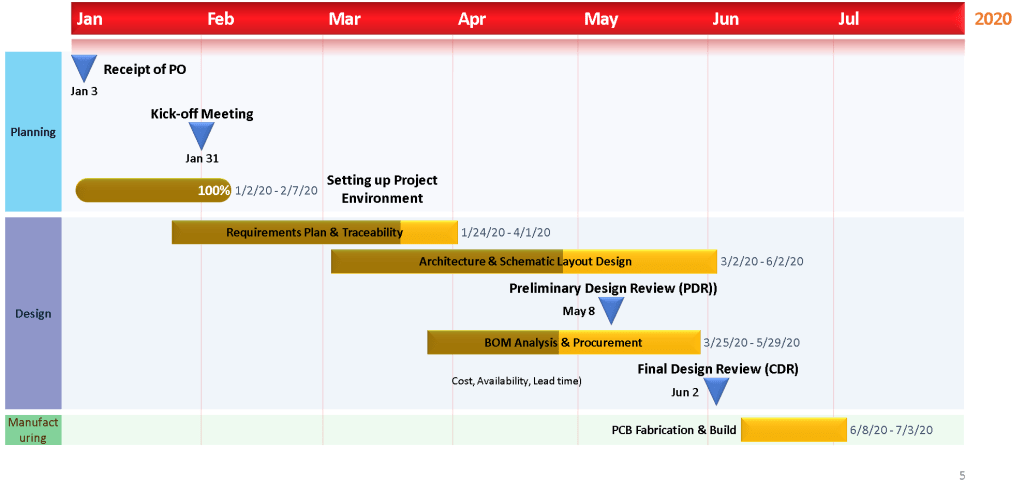
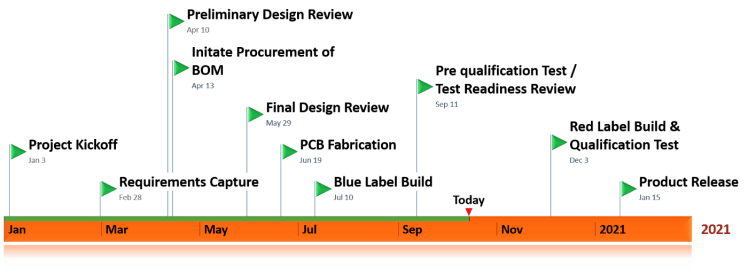
It is important to have good understanding about the End-2-End Product Development Lifecycle.
Addins (3) Advanced Excel (18) Agile (23) Blog (21) business (1) Clarity (3) Cloud Computing (3) Confluence (3) Dashboards (21) Data Analytics (17) Data modelling (9) DAX (17) Downloads (2) excel (1) GenAI (8) Jira (12) kanban (1) KPI (2) Loop (1) Motivation (3) MS Project (1) MS Teams (3) OneNote Tutorial (2) Outlook (1) PMO (72) Power BI (50) Power BI Dashboards (1) Power BI Desktop (28) Power BI service (2) Powerpoint (5) Power Query (3) Product Development (2) Productivity Tips & Tricks (59) project-management (4) Project Governance (2) Project Online (1) Ravindrapandian (1) Roadmap (2) scrum (5) scrum-master (2) Sharepoint Online (2) Smartsheet (5) Sway (1) Team Bonding (1)
Discover more from LR Virtual Classroom
Subscribe to get the latest posts sent to your email.
 LR Virtual Classroom