
Often, its really overwhelming when we were asked to present the data to Directors and Senior stakeholders. It’s natural human tendency to feel anxious but it can be overcome by strategic preparation. I personally feel there are a lot of elements involved while presenting the data to Directors. This post consolidates all the key learning…from personal experiences and via various sources. At least, this will serve as a checklist when presenting to senior stakeholders. Of course, Planning, Preparation and Practice makes anything to be Perfect.
As Executive’s day is filled with decision making, problem solving…..its very important to communicate right.
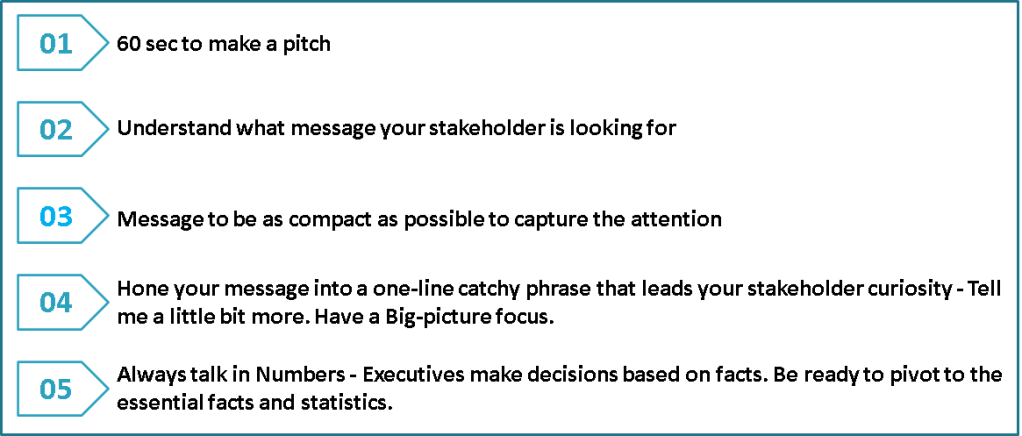
Here’s the 5 step strategy to get it right the first time.
Step 1 – Key Strategies:
Step 2 – Be Prepared:
There are few things to keep in mind while getting prepared for our meetings.
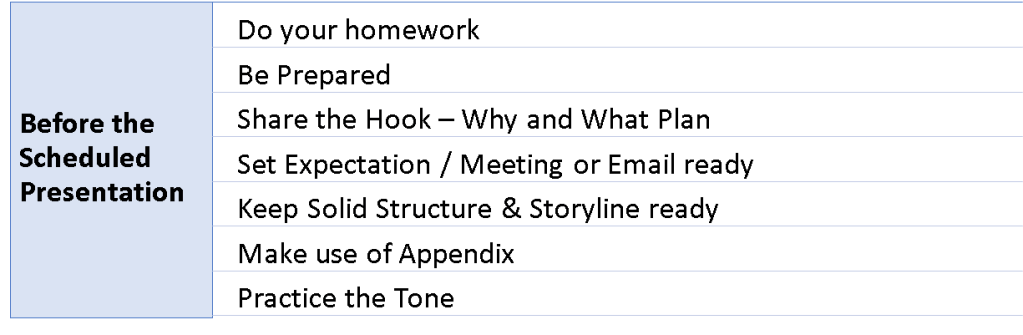
Do remind that “Your presentation is the practiced-speaking, whereas the Q and A section is impromptu-speaking.
Step 3 – Framing your message to Executives:
It is important to understand what we are trying to achieve in the meeting to help us be prepared with the message.
- Are we giving an update?
- Are we sharing your high level research that you have done?
- Are we unveiling a problem, or proposing a solution?
If our message is informative, we need to include a brief preview of our main points. Have it framed in short and simple – In short, a brief executive summary. This should include key takeaways with facts & figures.
If our message is persuasive, we need to share the conclusion first and then shift move backward to moving to the facts and problem analysis including the problem, solution & opportunities using anologies.
The message set up for the executive audience first hit on the emotion first with a strong tone of facts and logic to follow.
For eg: Because of this problem or opportunity we need to do this _____(main idea). Doing this would help us because ______ (why this matters – list at least three reasons). To close, we need to do this _____ (call to action).
An delivery tone & the pitch resulting from detailed practice will help us sound prepared and get our stakeholder attention. Facts are important but emotional appeal comes from story, connection and visual language describing the topic.
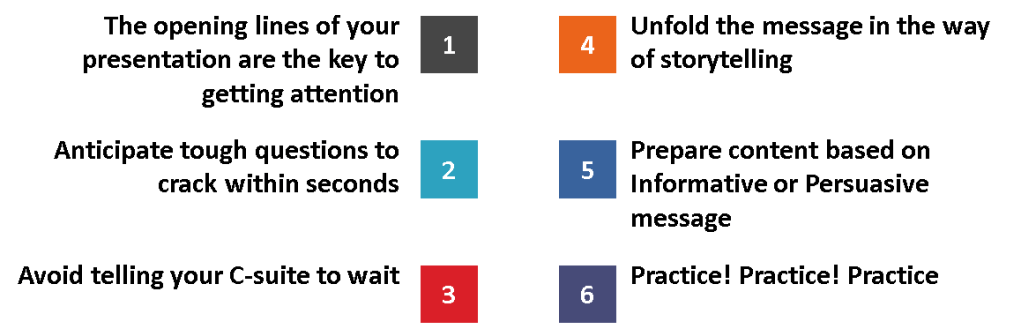
Step 4 – Creating a Value-add presentation:
Most of the times, our meeting with Executives ends up with making a decision for a problem or opportunity. Hence we need to present with logic.
Facts and Evidence speaks more than words. Here’s the 5 important pillars of the presentation.
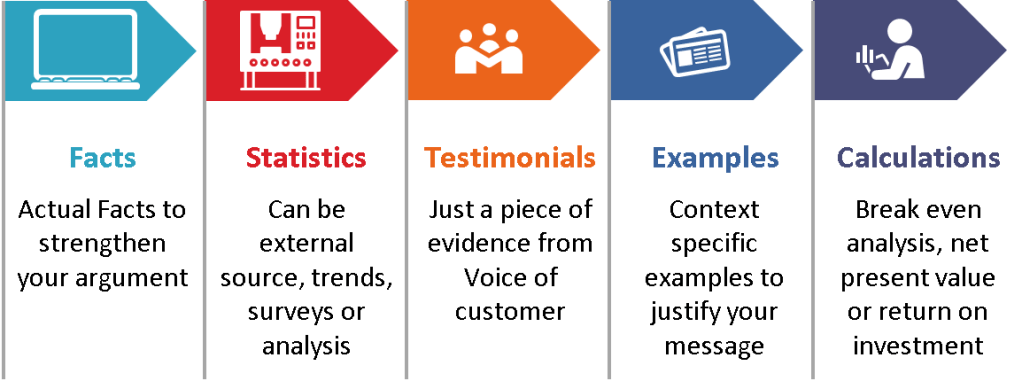
Step 5 – Post Meeting Etiquette:
Timing is all important as the day of the senior stakeholders is packed with meetings, discussions, decisions and directions.
Sending the concise post meeting communication is very important. Start with the appreciation and brief recap should come out first thing after the meeting and follow up needs to be precise capturing all the details while they are fresh in the mind.
Important to highlight all the key main points and summary of the important decisions made during the meeting along with action items.
Mention that, you will circle back in a week with an update/follow up.
Bonus Step 6 – Do’s and Don’ts:
📗 Irrespective of the preparation, there at time we may face multiple scenarios.
✅ If the meeting has been cut short from 30 to 15 min, you need to have summary slide ready to highlight the Why, What, How When, Whom and Where questions related to your data – Create single page summary of your content (One-page memo).
✅ Be prepared with the 30 sec pitch as well in case if the meeting had to be cancelled due to uncertain event.
✅ Carry your own mouse clickers or laser pointers. Its very handy and you don’t need to relay on mouse.
✅ Don’t get distracted if the senior stakeholders are endorsed in their mobiles during meetings or not having eye contact. Don’t take it personally. Engage yourself by saying keywords like ” key sales”, latest findings”, important decision points, key actions” etc to bring attention of the senior stakeholders.
✅ If there are any discussion during the meeting, pause and ask if you should proceed or pause for a minute. Its important to manage the interruptions with warmth and confidence. Our goal is to build rapport with the executive.
✅ Avoid the yes or no answer. Extend with the examples, explanation of what and why.
✅ Use short phrases such as, “I’m glad you asked this question” or ” yes, I struggled with the same question when I researched this” or “thank you for bringing this up”.
✅ Always have a presentation backup plan stored in SharePoint or email or sharedforlder.
✅ Prepare, Prepare & Prepare – Shows your competence of your content. Break down and drill down the high level details
Hope you find it relevant….Looking forward for your strategy…
Discover more from LR Virtual Classroom
Subscribe to get the latest posts sent to your email.
 LR Virtual Classroom