As a PMO, you are working with multiple stakeholders.
You need to work hand-hand most of the time. It is termed by the word – Buy-In.
Buy-in is getting the concurrence from your team by why your idea achieves their goals. Sounds simple, right?
In reality, it is difficult to do being in PMO, in that case any job as well. It is skill one has to acquire and get expertise.
Common Reasons for Buy-In failure:
In fact, over the years, I’ve realized there are three common reasons why one will fail to get buy-in.
1. Assuming everyone is thinking what you’re thinking
We assume that whatever we say is the right answer all the time. The process or the ideas that you are trying to project may not be the same until all of them are in the same page.
Solution: Including the below steps will help definitely help to bridge the gap between everyone.
- List down as detailed as possible on paper.
- It is important to highlight all the assumptions, exclusions, advantages, disadvantages
2. Feeling time-crunched
We always fear that there is not enough time. This will make us limit ourselves in our ideas or thought process.
Solution: Seek sufficient time before you roll out the process. Buy-Time is important for Buy-In.
3. Fear of disagreement
Fear of failure, Fear of disapproval – We’re afraid someone will disagree, so we try to sneak the plan through.
Sometimes we do not even know we are in fear.
ASCEND Checklist:
When we fail to get buy-in, we feel frustrated.
We think our career growth is struck.
We feel our reputation is taken a hit.
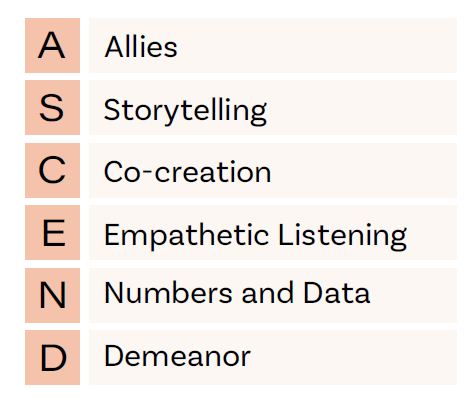
Follow the ASCEND checklist before you go for the buy-in meeting.
Allies: Build credibility to your idea/process with your team.
Storytelling: Communicate the message that it resonated with your audience. Your message should include
- Relevance ( why should people care?)
- Message (What is the key single point?)
- Rationale ( 2-3 reasons to support your key point?)
First, entice the stakeholders, then engage them by asking questions and then educate them. This is called as EEE Model of storytelling.
- Entice
- Engage
- Educate
Co-Creation: It is important to work in a team as you can get different perspectives. Leverage that.
As a PMO, you don’t need to come with best idea. You need to execute on the best idea.
Lashmi
- Ask open-ended questions – What I am missing?
- How can we make this better?
- Can you please walk us through your thinking?
Empathetic Listening: Listening actively is the key important skill.
Ask questions like
Ask questions that promote discovery
- Tell me more?
- How would you do this?
- What are your concerns?
Build a person’s self-esteem
- I know you are an expert? I love to get your insights?
- I’d value your opinion here.
Make suggestions
- That’s interesting. It made me think of <your thoughts>
- IF I’m hearing you correctly, this is what you are saying?
Numbers & Data:
Data build credibility. It’s no longer what you think? It is objective more than being subjective.
Demeanor: Show self-confidence in your words and body language.
Get rid of qualifiers like “actually”, quickly”, just think that”, I have a quick question”.
Hope you enjoyed this post.
Discover more from LR Virtual Classroom
Subscribe to get the latest posts sent to your email.
 LR Virtual Classroom