
Earning my PMI-Agile Certified Professional Certification on 25th Jan 2025 was more than just a career milestone: it was an eye-opener.
As an Agilist, I naturally started implementing Agile methodologies, tools, and techniques at home, and the results were truly transformational.
Seeing firsthand how Agile principles help children become more organized, adaptable, and responsible reinforced my belief that Agile isn’t just for the workplace: it’s a mindset that can shape life skills from an early age.
Here are some Agile principles that can help children in their studies, hobbies, and daily routines.
1. Daily Reflection with “Mad, Sad, Glad”
Instead of bottling up emotions, children can use a simple reflection exercise to understand their feelings and experiences.
At the end of each day, ask:
- What made me mad today? (Something that frustrated me)
- What made me sad today? (Something that upset me)
- What made me glad today? (Something that made me happy)
This helps children become more self-aware, express themselves better, and focus on continuous improvement.
2. Using a Kanban Board for Tasks Management
A Kanban board helps children keep track of their schoolwork, extra curricular, and personal goals.
How to Set It Up:
- To-Do: Homework, reading, assignments, or any tasks for the day
- In Progress: Tasks currently being worked on
- Done: Completed tasks
Kanban Board Before Exams
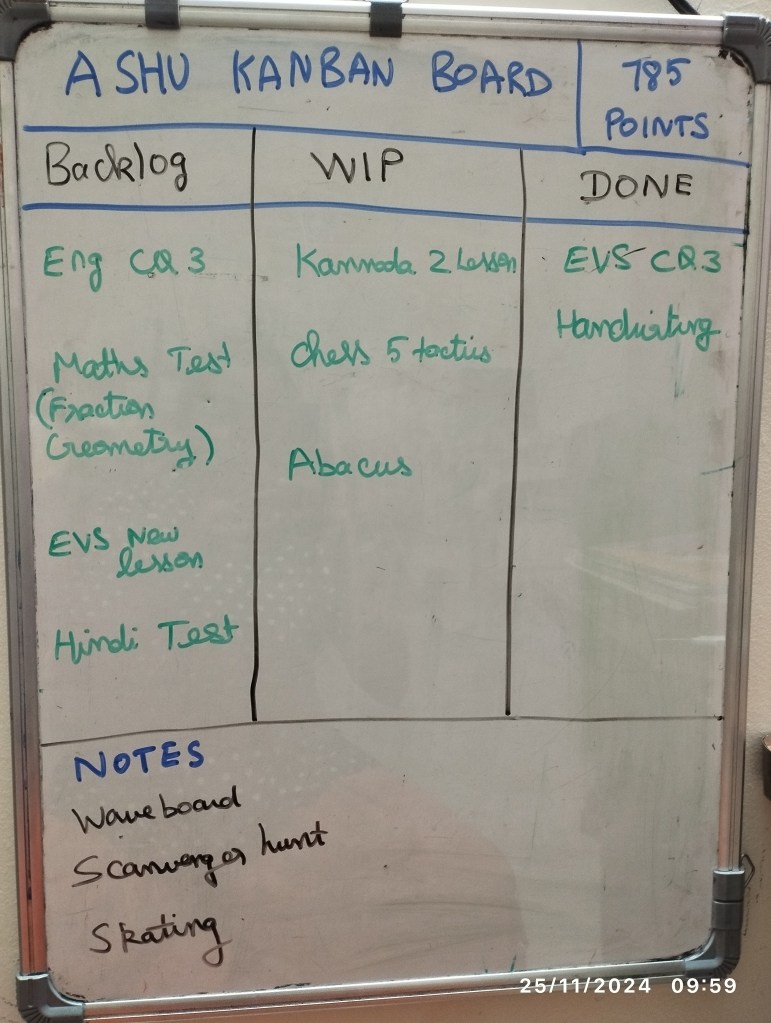

The board is spotless after Exams! No tasks left
3. Time-Boxed Study Approach (Sprints)
Instead of trying to finish everything at once, children can break their work into small, manageable sections.
How it helps:
- Setting short study periods (like 30 minutes per subject) keeps learning structured
- Avoids last-minute stress before exams
- Small achievements keep motivation high
4. Parkinson’s Law: Work Smarter, Not Longer
Parkinson’s Law states that “work expands to fill the time available for its completion.”
What this means for kids:
- If there is no deadline, they might take longer to complete homework
- Setting a time limit (e.g., 30 minutes per subject) helps finish work faster
- This creates urgency and improves focus
5. Pomodoro Technique for Focused Learning
Children can study more effectively using the Pomodoro Technique, working in focused 25-minute sessions with short breaks in between.
Benefits:
- Increases concentration
- Prevents burnout
- Helps retain information better
I wish I had known about this technique in college instead of studying for long hours without breaks!
6. Reducing Waste with Lean Thinking
Children can learn to use their time efficiently by avoiding common distractions.
The 8 Types of Waste (DOWNTIME) in Daily Life:
- Defects: Making mistakes in homework, bad writing, incomplete work that requires rework
- Overproduction: Spending too much time on unnecessary tasks
- Waiting: Learning when to wait and how to reduce waiting time
- Non-Utilized Talent: Finding fun ways to learn using games, visuals, and real-world examples
- Transportation: Avoiding unnecessary movement, like constantly switching study spots or long commutes to tuition classes
- Inventory: Keeping unfinished assignments under control using a Kanban board or buying stuffs again and again.
- Motion: Keeping study materials in one place to avoid searching for them
- Extra Processing: Keep in simple when doing any content creation or projects.
7. The “Five Whys” Technique for Problem-Solving
By asking “Why?” five times, children can get to the root cause of a problem.
Example 1: Struggling with Homework
Problem: “I don’t want to do my homework.”
Why? “Because it’s too hard.”
Why? “Because I don’t understand the topic.”
Why? “Because I missed the explanation in class.”
Why? “Because I was distracted.”
Why? “Because I didn’t sleep well last night.”
Solution: The real issue isn’t homework—it’s lack of rest. Fixing the sleep routine helps solve the problem.
Example 2: Always Late for School
Problem: “I’m always late for school.”
Why? “Because I take too long in the morning.”
Why? “Because I can’t find my uniform and books.”
Why? “Because I don’t prepare them the night before.”
Why? “Because I forget or feel lazy at night.”
Why? “Because I don’t have a proper checklist.”
Solution: A bedtime checklist can help avoid morning stress.
8. Learning by Teaching – (Inspired by Pair Programming)
One of the best ways for children to truly understand a topic is by explaining it to someone else. So, why not ask your child to teach you what they learned today?
How It Works:
- Let them be the teacher: Ask your child to explain a math problem, a science concept, or a history lesson to you.
- Encourage questions: If they struggle to explain something, it highlights areas they need to review.
- Make it fun: Have them use a whiteboard, draw diagrams, or create a mini-presentation.
- Boosts confidence: Teaching improves their communication skills and helps them feel more accomplished.
By making this a daily habit, children will retain knowledge better, develop a deeper understanding, and enjoy the learning process. Try it today. What will your child teach you?
8. Turning User Story Points into Rewards for Kids
Assign user story points to tasks based on effort (e.g., 1 point for easy, 5 for difficult). Once completed, convert these points into rewards (e.g., 1 point = 1 INR or a privilege).
This makes tasks fun, structured, and motivating, helping kids prioritize, plan, and stay disciplined, all while learning Agile in a practical way!
Conclusion
Agile is not just about facilitating meetings or solving problems, it’s a way of thinking, a mindset that encourages continuous learning, adaptability, and resilience.
It’s high time we move beyond just "Doing Agile" and start "Being Agile" in real life.
By fostering this mindset in children, we empower them with skills that go far beyond academics, helping them embrace change, think critically, and continuously improve.
It’s amazing how these Agile principles can help children stay organized, focused, and adaptable in daily life. By applying these simple techniques, kids can:
- Manage their time better
- Stay motivated and stress-free
- Build problem-solving skills
- Develop a habit of continuous learning
By introducing these Agile ideas early, children can grow into self-sufficient, resilient individuals who are ready for anything life throws their way!
Discover more from LR Virtual Classroom
Subscribe to get the latest posts sent to your email.
 LR Virtual Classroom