Have you ever stumbled upon a new approach and wondered if it could be the secret ingredient to solve some of your project management challenges?
Recently, I came across something quite intriguing: the Design Thinking process. It’s one of those concepts that make you stop and think, “Why haven’t I been using this all along?”
Today, let’s dive into what makes Design Thinking so compelling and how it could transform our project management approach.
The Spark of Curiosity
“So, during our recent All-Hands meeting, one of our leaders brought up something that really caught my attention: Design Thinking.
I was intrigued by the way this approach was described, and it made me realize just how relevant it could be for our projects.
In fact, we implemented in the various Automation & Process Improvement initiatives.
The leader emphasized how Design Thinking isn’t just a tool for designers but a powerful methodology that can transform how we tackle challenges and drive innovation in our PMO practices.
This got me thinking about how we might leverage these principles to enhance our project management strategies and achieve better outcomes.”
Initially, I thought, “Isn’t this just for designers and marketers?” But as the talk unfolded, it became clear that Design Thinking isn’t just a buzzword—it’s a powerful framework that we used in one of the projects that I worked On.
The Essence of Design Thinking
At its core, Design Thinking is about solving problems in a user-centered, empathetic way.
It’s a process that prioritizes understanding the needs and experiences of end-users, and it involves several stages:
Here’s a simple breakdown of the five stages in the Design Thinking process:
- Empathize: Research and understand what your users need and feel.
- Define: Clearly state the problems and needs of your users.
- Ideate: Brainstorm and come up with creative ideas to address those problems.
- Prototype: Build simple versions of your ideas to explore how they might work.
- Test: Try out your prototypes with users and gather feedback to improve them.
How PMOs can leverage the Design Thinking Process in their day-to-day work
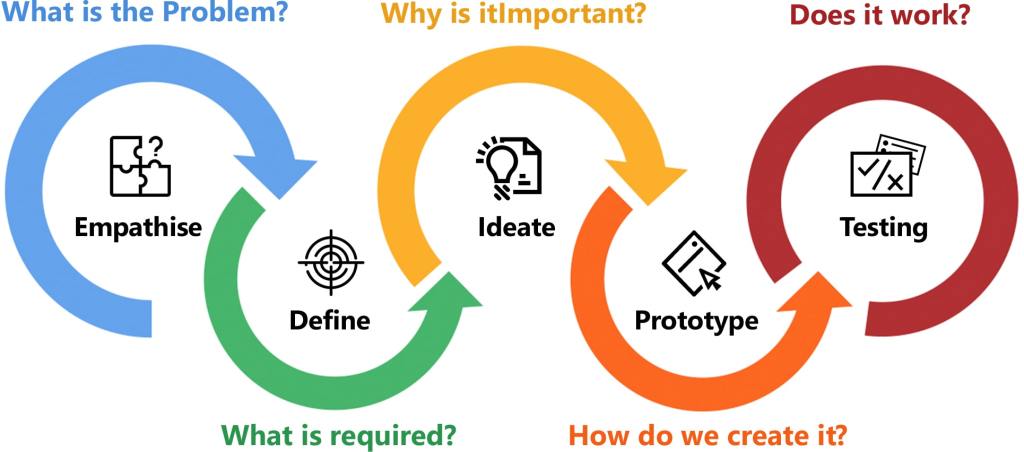
- Empathize: This is where it all starts. It’s about getting into the shoes of your stakeholders. For PMOs, this means understanding the challenges and needs of your project team, clients, and end-users. Conduct interviews, observe behaviours, and really listen. The goal is to build a deep, empathetic connection to the people you’re serving.
- Define: Once you’ve gathered insights, the next step is to define the problem. This involves synthesizing your findings to pinpoint the core issues. Think of this as crafting a clear and concise problem statement that reflects the real needs of your stakeholders.
- Ideate: Here’s where creativity takes center stage. Brainstorm a wide range of ideas and solutions. No idea is too far-fetched at this stage. Encourage your team to think outside the box. In the PMO world, this could mean exploring innovative ways to streamline processes or enhance stakeholder engagement.
- Prototype: Now, it’s time to bring ideas to life. Create tangible representations of your solutions. Prototypes can be anything from wireframes and mockups to pilot programs. The goal is to test your ideas in the real world and gather feedback.
- Test: Finally, test your prototypes with actual users. Collect feedback, identify what works and what doesn’t, and iterate on your solutions. This iterative process helps refine your approach and ensures that you’re on the right track.
Bringing Design Thinking to Project Management
So, the advantages of the Design Thinking Process are,
- Enhanced Problem Solving: By focusing on empathy and user needs, Design Thinking helps ensure that the solutions you develop are truly addressing the underlying issues, not just symptoms.
- Increased Innovation: The ideation phase encourages creative thinking, which can lead to innovative solutions that differentiate your projects from the competition.
- Improved Stakeholder Engagement: Engaging stakeholders early and often in the process helps build stronger relationships and ensures that their needs are always top of mind.
- Better Risk Management: Testing prototypes and gathering feedback helps identify potential risks early, allowing you to address them before they become major issues.
Do’s in Design Thinking
- Do engage with users to understand their needs and perspectives.
- Do define problems clearly based on user insights.
- Do encourage creativity and explore a wide range of ideas.
- Do build and test prototypes to gather real feedback.
- Do iterate on your solutions based on user feedback.
Don’ts in Design Thinking
- Don’t assume you know what users need without talking to them.
- Don’t settle for the first idea; explore multiple solutions.
- Don’t skip the prototyping phase; it’s crucial for testing ideas.
- Don’t ignore feedback; it’s essential for refining your solution.
- Don’t rush the process; give each stage the attention it needs.
A Real-World Example
Imagine you’re leading a project to implement a new project management tool across your organization. Using Design Thinking, you’d start by empathizing with users who will be interacting with this tool daily.
You’d identify their pain points, define their needs, and brainstorm a range of features and functionalities that could address these needs.
You’d then create prototypes of the tool and test them with a select group of users, iterating based on their feedback before rolling out the final product.
That how we approached and executed in the Concourse Delivery Map Project
Wrapping Up
Design Thinking isn’t just for designers; it’s a versatile approach that can revolutionize how PMO professionals tackle complex challenges.
By embedding empathy, creativity, and iterative testing into your project management processes, you can drive innovation, enhance stakeholder satisfaction, and deliver impactful solutions.
So, the next time you’re faced with a tricky problem or looking for ways to improve your project outcomes, consider giving Design Thinking a try. It might just be the game-changer you’ve been looking for!
Until next time, keep thinking creatively and solving problems with empathy!
Discover more from LR Virtual Classroom
Subscribe to get the latest posts sent to your email.
 LR Virtual Classroom