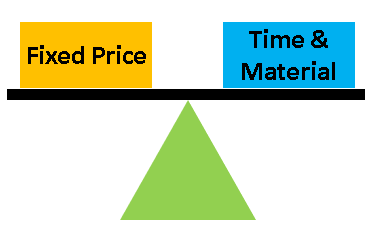
Understanding the Contract type is the very first step in the Project Management. As the contract documents are binding and legally enforcing, it is important to understand the type of contract it has been signed.
As a Client, consequences of choosing the wrong type of contract in terms of not having way of changing or replacing features, ending up building a product that is not adaptable to latest technology or going way over your budget, can be severe to your business. As a service provider, it drives the way you plan your project, estimate revenue & budget, execution of milestones, deliverables tracking, invoicing & billing etc.
While the contract documents comprises of various details not limited to SOW, Scope, Deliverables, Timelines, Acceptance criteria, Contract Clauses, Payment terms, Standards etcetera, lets see in detail about the two major types of contract and its Pros & Cons.
- Fixed Price contract
- Time & Material contract
In addition to above, there is called Milestone contract, where the customer provides regular payments for accomplished milestones. The payment for each milestone can be fixed or costs on actuals.
In my construction experience, there is a third type of contract called “Cost reimbursable contract”. The Client pays contractor for the actual cost of the work which includes direct and indirect costs such as labors, materials, equipment etc. Contractors will add a clause, such as a fixed fee or some percentage of incentive as a profit.
Fixed vs Time & Material
| Category | Fixed Price | Time & Material |
|---|---|---|
| Project Cost | The budget is fixed upfront of the project. Single – sum contract throughout the project. | The budget is flexible based on Man-hours, Machineries etc. Hourly rates throughout the project. |
| Project Scope | Requirements, specifications are clearly defined , agreed before the project kickoff which means the deadlines are fixed. | High flexibility to change the scope, requirements & timeline. Detailed requirements are not needed in the contract. |
| Type of Project Application | Usually applied when you want to build a Minimum viable product (MVP) or in case of small , short term & limited budget projects. | Mostly applied to dynamic requirements, New Product Development (NPD), long term & uncertain projects. |
| Development Methodology | Typically follows Waterfall model. Think of building a house. Project phases from Requirements to Maintenance are sequential. | It follows the Agile methodology -It allows Flexibility and Adaptivity in Project Phases and also deliverables. |
| Payments | As per the defined timeline on completion of milestones. | Pay as you go pricing model. |
| Client Participation | Little involvement is required. Mainly at the kick off and closing phase. | Active involvement throughout the phase of the project to ensure work is being done at a pace. |
| Management Involvement | Very minimal involvement is bearable. | Periodic involvement is required from the management else margin can go for a toss. |
| Product Adaptability | Any major new product features or adapting the new technology should be treated as new contract/project and in turn new investment again. | As the requirements are flexible and phases are iterative and incremental, new features can be added and you get the best-in class quality product at the end of the contract. |
| Major Pros | 1. Well stated requirements. 2. Predefined budget and timelines. 3. Low risk & high RoR (Win-Win situation mostly) 4. As a client, you you less management of work. | 1. High flexibility to add missing features after kick off. 2. Transparency in the execution process. 3. Ability to evolve and build custom top-notch software. 4. Precise payment so you can have good cashflow in your project. |
| Major Cons | 1. High risk of Investment for client if the features are missed or quality issues from vendor due to limited time. 2. Fixed scope so less adaptability in the product features. 3. More time spent in kickoff and planning. | 1. High risk in terms of Cost as expenses can be sky-rocketed during development. 2. Unclear timelines which means never ending project. 3. Need better monitoring & controlling system. |
To conclude,
As a Client – it is critical factor to weigh all the merits and demerits of each contract type and decide on the contract type based on how they can fit in your business is the key to success.
As a vendor, it is important to have right system of monitoring & control to meet the strategic goal in both the contracts.
Discover more from LR Virtual Classroom
Subscribe to get the latest posts sent to your email.
 LR Virtual Classroom